Organ-Specific Mobilization
This technique focuses on gently mobilizing specific organs to improve their function and relieve tension in the surrounding tissues.

Discover the Healing Power of Visceral Manipulation
Experience the transformative benefits of Visceral Manipulation (VM) therapy, a gentle and effective approach to improving your overall health and well-being.

Visceral Manipulation offers numerous benefits, particularly for residents of Tucson, AZ, and the surrounding areas. This therapy can help alleviate chronic pain, improve digestion, enhance mobility, and support emotional well-being. By addressing the root causes of dysfunction within the body’s internal systems, VM promotes holistic healing and long-term health. Whether you’re dealing with digestive issues, musculoskeletal pain, or stress-related conditions, Visceral Manipulation can provide a gentle and effective solution tailored to your unique needs.
This technique focuses on gently mobilizing specific organs to improve their function and relieve tension in the surrounding tissues.
Fascial release involves manipulating the connective tissue to reduce restrictions and enhance the mobility of the organs.
By stimulating neural pathways, this technique helps to restore proper communication between the organs and the nervous system.
Musculoskeletal, vascular, nervous, urogenital, respiratory, digestive and lymphatic dysfunction. It evaluates and treats the dynamics of motion and suspension in relation to organs, membranes, fascia and ligaments. Visceral Manipulation increases proprioceptive communication within the body, thereby revitalizing a person and relieving symptoms of pain, dysfunction, and poor posture.
An integrative approach to evaluation and treatment of a patient requires assessment of the structural relationships between the viscera, and their fascial or ligamentous attachments to the musculoskeletal system. Strains in the connective tissue of the viscera can result from surgical scars, adhesions, illness, posture or injury. Tension patterns form through the fascial network deep within the body, creating a cascade of effects far from their sources for which the body will have to compensate. This creates fixed, abnormal points of tension that the body must move around, and this chronic irritation gives way to functional and structural problems.
Imagine an adhesion around the lungs. It would create a modified axis that demands abnormal accommodations from nearby body structures. For example, the adhesion could alter rib motion, which could then create imbalanced forces on the vertebral column and, with time, possibly develop a dysfunctional relationship with other structures. This scenario highlights just one of hundreds of possible ramifications of a small dysfunction – magnified by thousands of repetitions each day.
There are definite links between somatic structures, such as the muscles and joints, the sympathetic nervous system, the visceral organs, the spinal cord and the brain. For example, the sinuvertebral nerves innervate the intervertebral disks and have direct connections with the sympathetic nervous system, which innervates the visceral organs. The sinuvertebral nerves and sympathetic nervous system are linked to the spinal cord, which has connections with the brain. In this way someone with chronic pain can have irritations and facilitated areas not only in the musculoskeletal system (including joints, muscles, fascia, and disks) but also the visceral organs and their connective tissues (including the liver, stomach, gallbladder, intestines and adrenal glands), the peripheral nervous system, the sympathetic nervous system and even the spinal cord and brain.
Thanks to the dedicated work of Jean-Pierre Barral, a Physiotherapist (RPT) and Osteopath (DO), healthcare practitioners today can use the rhythmic motions of the visceral system as important therapeutic tools.
Barral’s clinical work with the viscera led to his development of a form of manual therapy that focuses on the internal organs, their environment and the potential influence on many structural and physiological dysfunctions. The term he coined for this therapy was Visceral Manipulation.
Visceral Manipulation relies on the palpation of normal and abnormal forces within the body. By using specific techniques, therapists can evaluate how abnormal forces interplay, overlap and affect the normal body forces at work. The goal is to help the body’s normal forces remove abnormal effects, whatever their sources. Those effects can be global, encompassing many areas of bodily function.
Visceral Manipulation is used to locate and solve problems throughout the body. It encourages your own natural mechanisms to improve the functioning of your organs, dissipate the negative effects of stress, enhance mobility of the musculoskeletal system through the connective tissue attachments, and influence general metabolism. Today, a wide variety of healthcare professionals perform Visceral Manipulation. Practitioners include osteopathic physicians, allopathic physicians, doctors of chiropractic, doctors of Oriental medicine, naturopathic physicians, physical therapists, occupational therapists, massage therapists and other licensed body workers.
Visceral Manipulation is based on the specific placement of soft manual forces to encourage the normal mobility, tone and motion of the viscera and their connective tissues. These gentle manipulations can potentially improve the functioning of individual organs, the systems the organs function within, and the structural integrity of the entire body.
Harmony and health exist when motion is free and excursion is full – when motion is not labored, overexcited, depressed, or conflicting with neighboring structures and their mobility. Therapists using Visceral Manipulation assess the dynamic functional actions as well as the somatic structures that perform individual activities. They also evaluate the quality of the somatic structures and their functions in relation to an overall harmonious pattern, with motion serving as the gauge for determining quality.
Due to the delicate and often highly reactive nature of the visceral tissues, gentle force precisely directed reaps the greatest results. As with other methods of manipulation that affect the body deeply, Visceral Manipulation works only to assist the forces already at work. Because of that, trained therapists can be sure of benefiting the body rather than adding further injury or disorganization.
Some information and images provided by Levity Health AU
Visceral Manipulation is a gentle manual therapy that aids your body’s ability to release restrictions and unhealthy compensations that cause pain and dysfunction. Visceral Manipulation, or VM, does not focus solely on the site of pain or dysfunction, but evaluates the entire body to find the source of the problem.
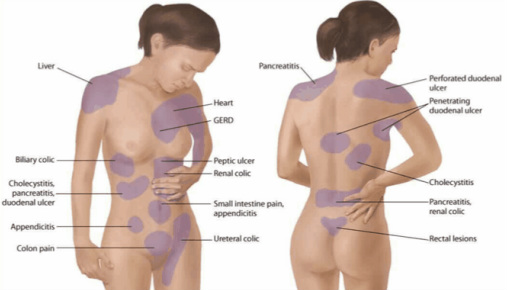
Fascia (connective tissue) is a continuous web that spreads throughout the entire body, much like a spider’s web. Its widespread effect goes to everything from our bones, and muscles to our internal organs — it literally connects our entire body. When we sustain injuries, have musculo-skeletal pains, surgeries, scars, and postural imbalances, the altered ‘pull’ on this continual web, can affect the normal physiological movement of our internal organs. This can impair the organs’ function, which can lead to referred pain patterns, through their various neurological connections.
Visceral Manipulation Can Benefit:
Lower Back Pain & Sciatica
Headaches & Migraines
Carpal Tunnel Syndrome
Joint Pain
Limited Mobility
Digestive Disorders
Swallowing Dysfunctions
Tendinitis
Whiplash Injuries
Birth Injuries
Neuralgia & Neuritis
Sprains & Traumatic Lesions
Thoracic Outlet Syndrome
And more.
Read more at Wikipedia
★★★★★
I am so impressed with my results after one appointment. Reva could feel it right away and spent a lot of time working it down. I felt a difference right away -- I can eat so much more now. She is so nice and very personable. She really cares.
★★★★★
She succeeded in two visits where $14,000 of specialists made no progress. Thank you for enabling me to get back to trail running.